User Code (C++)
This section assumes that you have a basic understanding of C++ and ROS 2. To learn ROS 2, please refer to Tutorials | ROS 2 Documentation.
Among the ROS packages included in a Tobas project created with Setup Assistant (example: tobas_f450.TBS), the user C++ package (example: tobas_f450_user_cpp) is a C++ package that the user can edit freely. It includes the following 5 launch files.
common_(interface/realtime).launch.py: Launched in both real hardware and simulation.real_(interface/realtime).launch.py: Launched only on real hardware.gazebo.launch.py: Launched only in simulation.
common and real each have two types of launch files, interface and realtime.
Nodes launched by the former can perform ROS communication across networks, whereas nodes launched by the latter cannot.
Therefore, for a node launched by *_realtime.launch to communicate across networks,
it must go through the interface node launched by *_interface.launch.
This mechanism is used to avoid negative effects on real-time performance caused by the DDS node discovery algorithm, which is the backend of ROS 2.
As an example, let's create a C++ node that checks the GNSS status and publishes a message every second when 3D positioning is available.
Please edit tobas_f450_user_cpp/tobas_f450_user_cpp/user_node.cpp as follows.
#include <tobas_constants/ros_interface.hpp>
#include <tobas_node/node.hpp>

#include <tobas_msgs_adapter/gnss.hpp>

class GnssStateCheckerNode : public tobas::BaseNode
{
  using self = GnssStateCheckerNode;
  using super = tobas::BaseNode;

public:
  explicit GnssStateCheckerNode(const rclcpp::NodeOptions& options = rclcpp::NodeOptions());

private:
  tobas::ros2::SubscriberPtr<tobas_msgs::Gnss> gnss_sub_;

  void gnssCb(const tobas_msgs::Gnss::ConstSharedPtr& gnss);
};

GnssStateCheckerNode::GnssStateCheckerNode(const rclcpp::NodeOptions& options)
  : super("gnss_state_checker", nodeOptions_Default(options))
{
  gnss_sub_ = createSubscriber<tobas_msgs::Gnss>(tobas::topic::kGnss, &self::gnssCb, this);
}

void GnssStateCheckerNode::gnssCb(const tobas_msgs::Gnss::ConstSharedPtr& gnss)
{
  if (gnss->fix_type == tobas_msgs::msg::Gnss::FIX_3D) {
    TOBAS_INFO_THROTTLE(1., "GNSS 3D Fix");
  }
}

RCLCPP_COMPONENTS_REGISTER_NODE(GnssStateCheckerNode)
Add this node to the build target.
Add the dependent packages to tobas_f450_user_cpp/CMakeLists.txt and uncomment the build process.
cmake_minimum_required(VERSION 3.25)
project(tobas_f450_user_cpp)

if(NOT CMAKE_BUILD_TYPE AND NOT CMAKE_CONFIGURATION_TYPES)
  set(CMAKE_BUILD_TYPE "Release" CACHE STRING "Build type (default Release)" FORCE)
endif()

set(CMAKE_CXX_STANDARD 23)
set(CMAKE_CXX_STANDARD_REQUIRED ON)
set(CMAKE_CXX_EXTENSIONS OFF)
set(CMAKE_CXX_FLAGS "${CMAKE_CXX_FLAGS} -Wall -Wextra -Wpedantic -Wshadow -Wswitch-enum -Werror")
set(CMAKE_POSITION_INDEPENDENT_CODE ON)

set(AMENT_DEPENDENCIES
  rclcpp
  rclcpp_components
  tobas_constants
  tobas_node
  tobas_msgs_adapter
)

find_package(ament_cmake REQUIRED)

foreach(dependency IN ITEMS ${AMENT_DEPENDENCIES})
  find_package(${dependency} REQUIRED)
endforeach()

include_directories(include)

add_library(${PROJECT_NAME} SHARED nodes/user_node.cpp)
ament_target_dependencies(${PROJECT_NAME} ${AMENT_DEPENDENCIES})
target_link_options(${PROJECT_NAME} PRIVATE -Wl,--no-undefined)
rclcpp_components_register_node(${PROJECT_NAME} PLUGIN "UserNode" EXECUTABLE user_node)

install(
  TARGETS ${PROJECT_NAME}
  EXPORT ${PROJECT_NAME}
  LIBRARY DESTINATION lib
  ARCHIVE DESTINATION lib
  RUNTIME DESTINATION bin
  INCLUDES
  DESTINATION include
)

install(DIRECTORY launch DESTINATION share/${PROJECT_NAME})

ament_package()
Configure the node to start automatically. You could launch it as a regular ROS node, but this time we will launch it as a component to eliminate copies in topic communication.
In Tobas, three component managers (component_manager_x (x = 1, 2, 3)) run on separate CPUs,
and topic communication between their components is also performed with zero copy.
Lower-numbered managers handle higher-speed processing with stricter latency requirements, and their rough roles are as follows.
component_manager_1: IMU filtering, state estimation, attitude/position control, etc. (400-800Hz)component_manager_2: Path planning, mission execution, etc. (30-100Hz)component_manager_3: Parameter server, logging, failsafe, etc. (1-10Hz)
Since the processing performed by the node launched this time is not latency-critical, plug it into component_manager_3, which handles the slowest processing.
In tobas_f450_user_cpp/launch/common_realtime.launch.py, uncomment the add_action section.
# Do not delete or rename this file because it is executed in tobas_f450_config/common_realtime.launch.py.

from launch import LaunchDescription
from launch_ros.actions import LoadComposableNodes
from launch_ros.descriptions import ComposableNode


def generate_launch_description():
    ld = LaunchDescription()

    # Please add the nodes that run both on real hardware and in simulation, with real-time requirements.

    ld.add_action(
        LoadComposableNodes(
            target_container=f"f450/component_manager_3",
            composable_node_descriptions=[
                ComposableNode(
                    package="tobas_f450_user_cpp",
                    plugin="UserNode",
                    extra_arguments=[{"use_intra_process_comms": True}],
                ),
            ],
        )
    )

    return ld
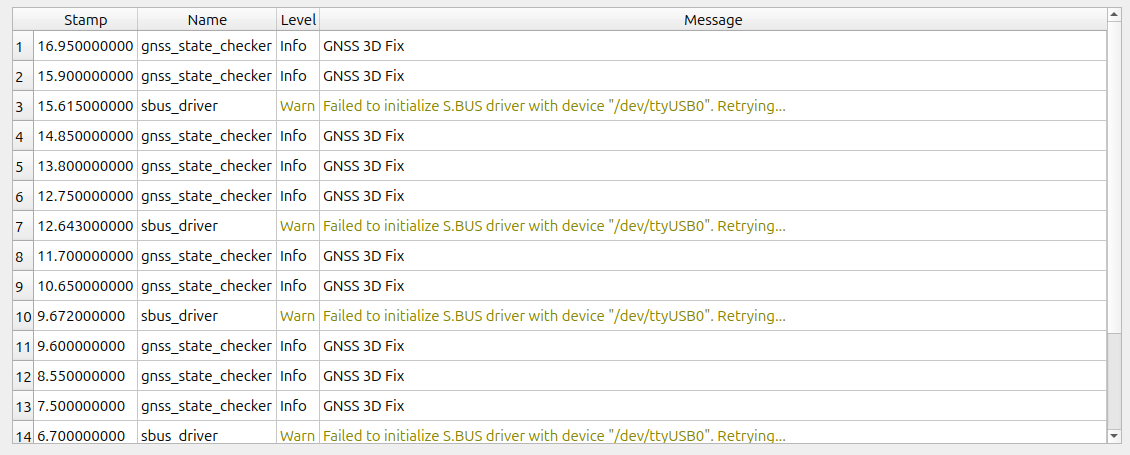
When you start the simulation from the GCS, a message will be displayed in the console of Control System.
For details on the API, see ROS API.