Tobas User Guide
Tobas is a flight controller for drones and robotic aircraft, built on model-based design and Linux. Its control system is designed with detailed consideration of each aircraft's structure, enabling precise flight even for aircraft that are difficult to control with conventional flight controllers.
Features
- Define the aircraft structure in a dedicated format so the controller accurately accounts for it
- Improve responsiveness and tracking accuracy through motor speed control
- Compensate for gravity loads and reaction forces as movable joint angles change
- Compensate for disturbances such as gusts and ground effect
- Configure the aircraft and control parameters through a GUI
- Support ROS 2 with the same interface for simulation and real hardware
Capabilities
Improved Control Performance
Tobas makes accurate use of your aircraft's physical properties in its control system, allowing it to deliver better control performance than conventional flight controllers. For example, it takes the following information into account:
- Mechanical parameters of each rigid link in the aircraft: mass, center of mass, and inertia tensor
- Battery specifications: cell count, discharge capacity, and discharge rate
- Motor specifications: KV rating, internal resistance, and number of magnetic poles
- Propeller specifications: diameter, pitch, thrust coefficient, and reaction torque coefficient
More Aircraft Design Options
Tobas defines aircraft structures using UADF (Universal Aircraft Description Format), allowing a wide range of aircraft that are difficult to fly with conventional flight controllers. For example, Tobas supports unconventional configurations such as:
- Aircraft with a center of mass significantly offset by a payload
- Aircraft with asymmetrically arranged propellers to keep the camera's field of view clear
- Aircraft equipped with robotic arms
- Aircraft equipped with tilt rotors
Less Gain Tuning
Accurate aircraft modeling allows the translational and rotational dynamics to be expressed in an aircraft-independent form and analyzed in advance. This allows Tobas to provide conservative default gains, so users can generally fly without tuning gains themselves. All parameters can also be adjusted online during flight if necessary.
Realistic Simulation
Accounting for aircraft mass properties and propulsion aerodynamics enables realistic physics simulation. This can significantly reduce the cost of testing with real hardware.
You can easily simulate factors that strongly affect flight, such as:
- Wind (steady wind, turbulence, and gusts)
- Battery voltage drop
- ESC current limits
- Sensor delays and noise
- Suspended payloads
Flight Management Unit (FMU)
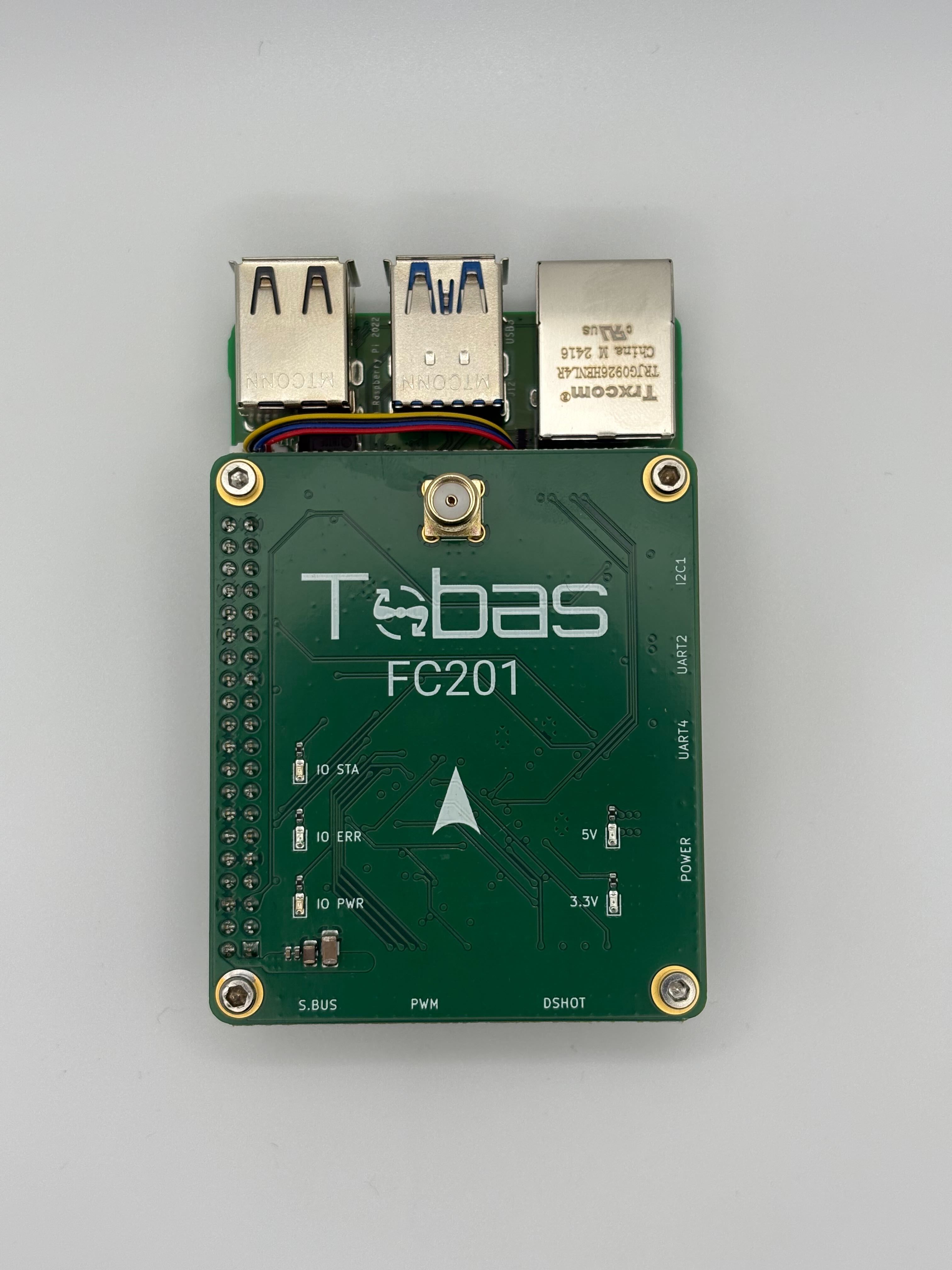
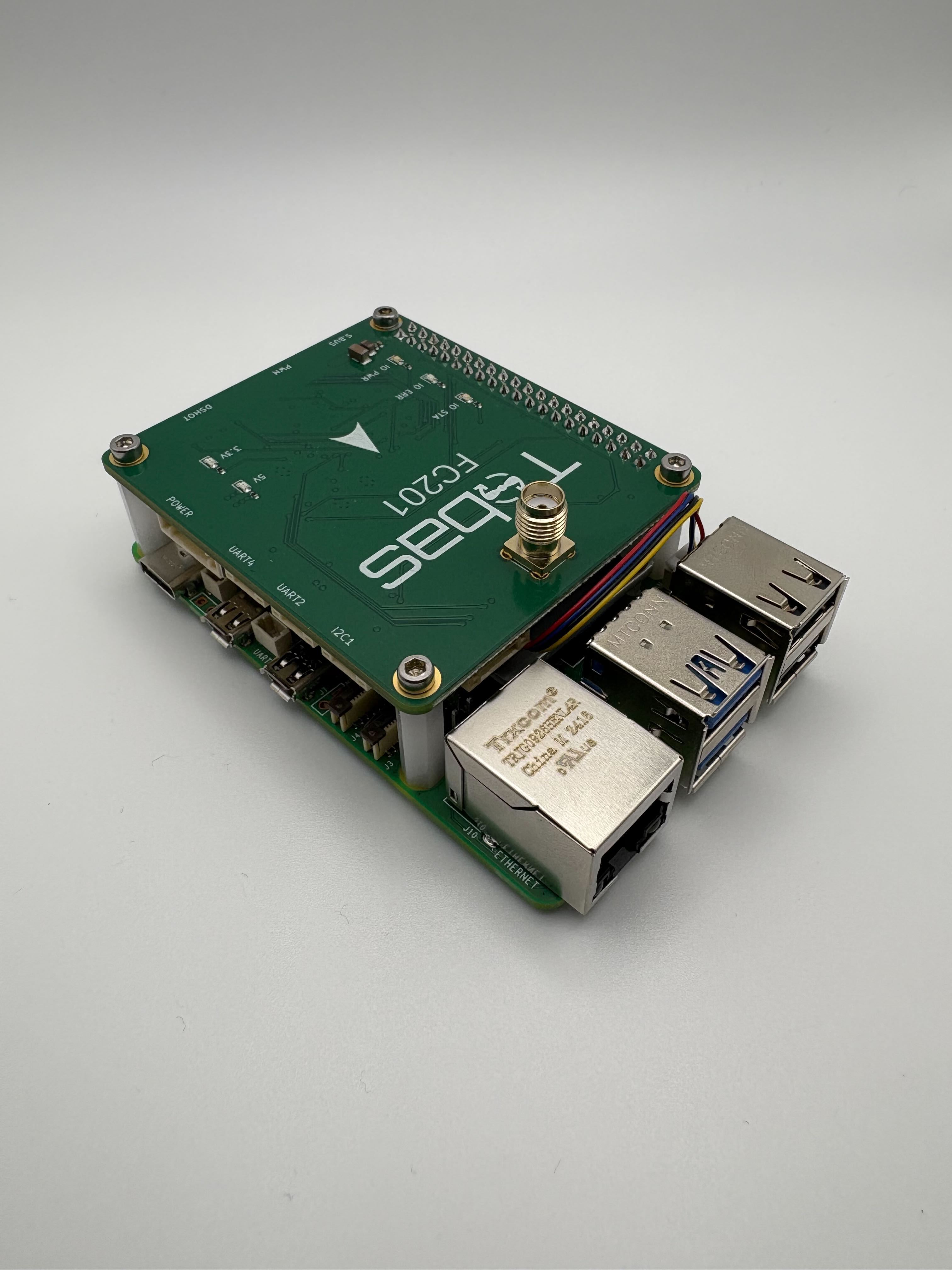
Tobas FC201
Sensors & Processors
- 6-axis IMU: ISM330DLC | STMicroelectronics
- Magnetometer: IIS2MDC | STMicroelectronics
- Barometer: ILPS22QS | STMicroelectronics
- GNSS Receiver: ZED-F9P | u-blox
- Voltage/Current Sensor: INA228 | Texas Instruments
- Main Computer: Raspberry Pi 5
- I/O Controller: STM32H7A3 | STMicroelectronics
Interface
- GNSS Antenna: SMA
- Power Module: Molex 2.0mm 6pin
- UART, I2C Interface: JST-GH 4pin
Examples
Quadcopter
A conventional quadcopter built with a DJI F450 frame kit.
Hexacopter with Noncoplanar Rotors
A hexacopter with all propellers tilted 30 degrees from the horizontal plane. While multicopters with coplanar rotors must change attitude to change position, multicopters with noncoplanar rotors can control position and attitude independently. They can therefore translate while remaining level, or change attitude while hovering. They can also generate horizontal thrust directly, providing high positioning accuracy and strong wind resistance.
Active-Tilt Hexacopter
A hexacopter whose arms can each rotate 120 degrees in either direction. It can make large attitude changes while hovering. Mounted equipment can be held at any attitude, making it a promising platform for applications such as nondestructive inspection of inclined walls.
Drone with a Robotic Arm
A tilt hexacopter equipped with a four-axis robotic arm. By dynamically compensating for reaction forces and changes in the center of mass caused by the arm, it keeps its position and attitude within a limited range even during large arm movements.
System Requirements
PC 
The following requirements must be met.
| Requirement | Required | Recommended | Notes |
|---|---|---|---|
| OS | Ubuntu 24.04 LTS (ROS 2 Jazzy) | Native installation recommended | |
| RAM | 8GB | 16GB | |
| CPU | AMD64 (x86-64) | ||
| GPU | NVIDIA GeForce RTX | ||
| Display resolution | FHD (1080p) | 4K UHD (2160p) |
ESC
The ESC must support the Bidirectional DShot protocol. Examples of compatible firmware include:
GNSS Antenna
The antenna must match the frequency bands and connector of the GNSS receiver on the FMU.
RC Receiver
The receiver must support S.BUS with at least eight channels.